Fitting short-form video inside a long-form streaming giant
Designing Clips — JioCinema's short-form vertical video feature — end-to-end, from navigation and creation flow to a new ad-monetization channel, inside a platform that hit a 32M-concurrent-viewer world record during IPL 2023.
Overview
Short-form video, without fragmenting a long-form audience
Short-form vertical video was winning attention everywhere, and JioCinema wanted in — not as a bolt-on, but as Clips: a 15-to-60-second video feed living inside an app people already used for long-form streaming and live sport. As lead product designer, my objective was a seamless, full-screen experience that could attract a younger, vertical-video-native audience (18–35) without confusing or fragmenting JioCinema’s existing viewers.
The real constraint wasn’t taste, it was context. Clips had to hit the engagement bar set by short-video-native rivals while sitting inside a platform that, at its biggest moment that year, carried a 32M-concurrent-viewer world record during IPL 2023 — meaning any friction in navigation or discovery would be felt at a genuinely enormous scale.
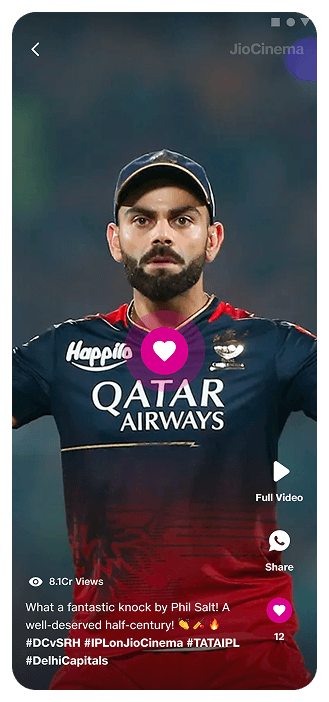
Goal
Primary goals
Increase User Engagement: Drastically increase the average time spent in the app and the frequency of daily visits.
Target New Demographics: Attract the younger audience (18-35) that is heavily consuming vertical video content.
Foster Content Creation: Establish an intuitive and simple creation flow to build a robust library of user-generated content.
Drive Monetization: Create a new, high-yield ad inventory space within the short-form feed.
Problem statement
Integrating short-form video into a long-form streaming service
The challenge was successfully integrating a fast-paced, addictive short-form video feed into a long-form streaming service without fragmenting the audience. The design needed to match the high engagement standard set by short-video rivals, overcome potential content discovery issues, and establish a clear, compelling identity for “Clips” within the larger JioCinema app.
Process
A five-phase design process, run in three passes
The standard empathize–define–ideate–prototype–test arc, compressed into three practical passes given an IPL-season timeline: understand the baseline short-form experience users already expected, build and pressure-test the core feed and creation flow, then validate on-screen controls and discovery logic with real usage data.
Emphasize & define
Studied user behavior on existing short-video platforms to understand the baseline expectation — instant delivery, full-screen immersion — then defined a personalized, infinite vertical feed built to minimize cognitive load.
Ideate, design, prototype
Brainstormed minimal navigation and quick-interaction patterns (tap-to-like, instant share), then built interactive prototypes of the core feed and creation flow to pressure-test speed and usability.
Test
Ran A/B tests on different on-screen control layouts and content-recommendation logic to optimize first-session retention, in Agile sprints alongside Monetization, Discovery, and Engagement teams.
Design
One navigation model, built for a cross-platform team
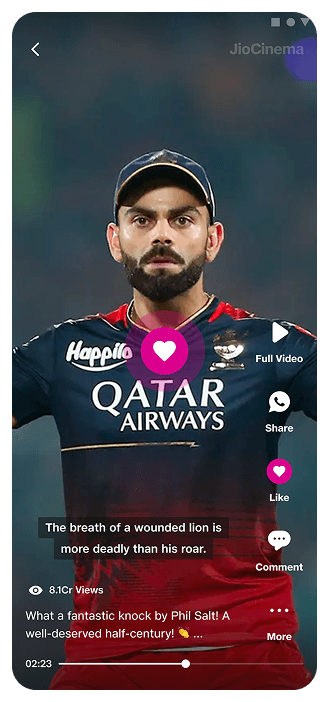
A single vertical swipe-up model for content discovery — the core navigation pattern the rest of the feature was built around.
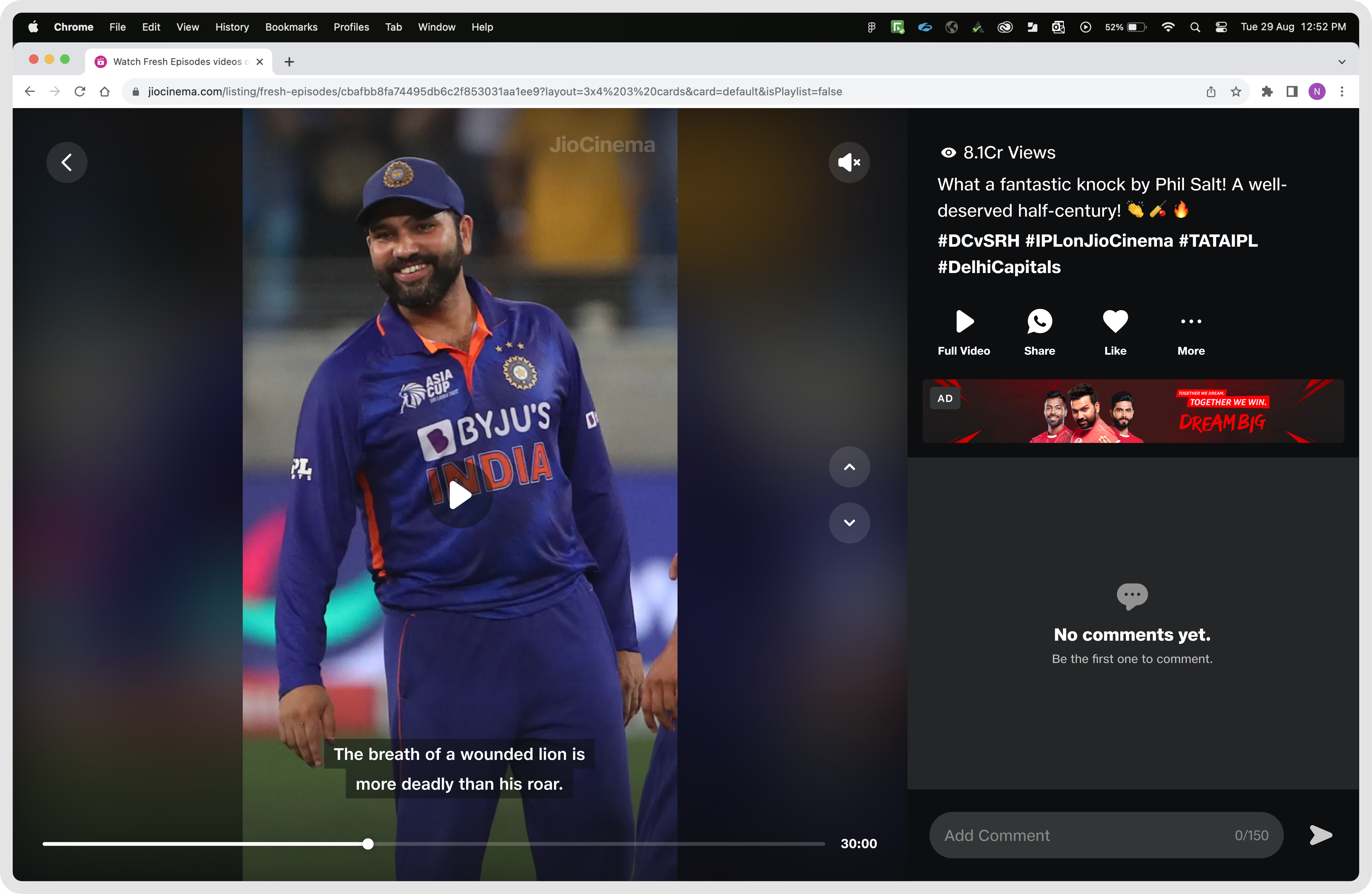
Full-screen, immersive playback with on-screen like/share/comment controls placed for one-handed, thumb-reach interaction.
Dedicated ad placements built into the feed itself, designed as a new inventory space rather than an interruption to it.
Reusable components contributed to a shared cross-platform design system, so Clips felt like the same product a viewer had just used for a cricket match — across web, Android, iOS, and TV.
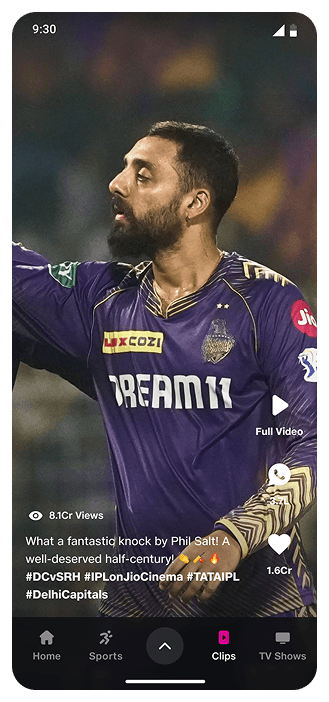
Desktop Phase 1
Clips scaled to the desktop web.
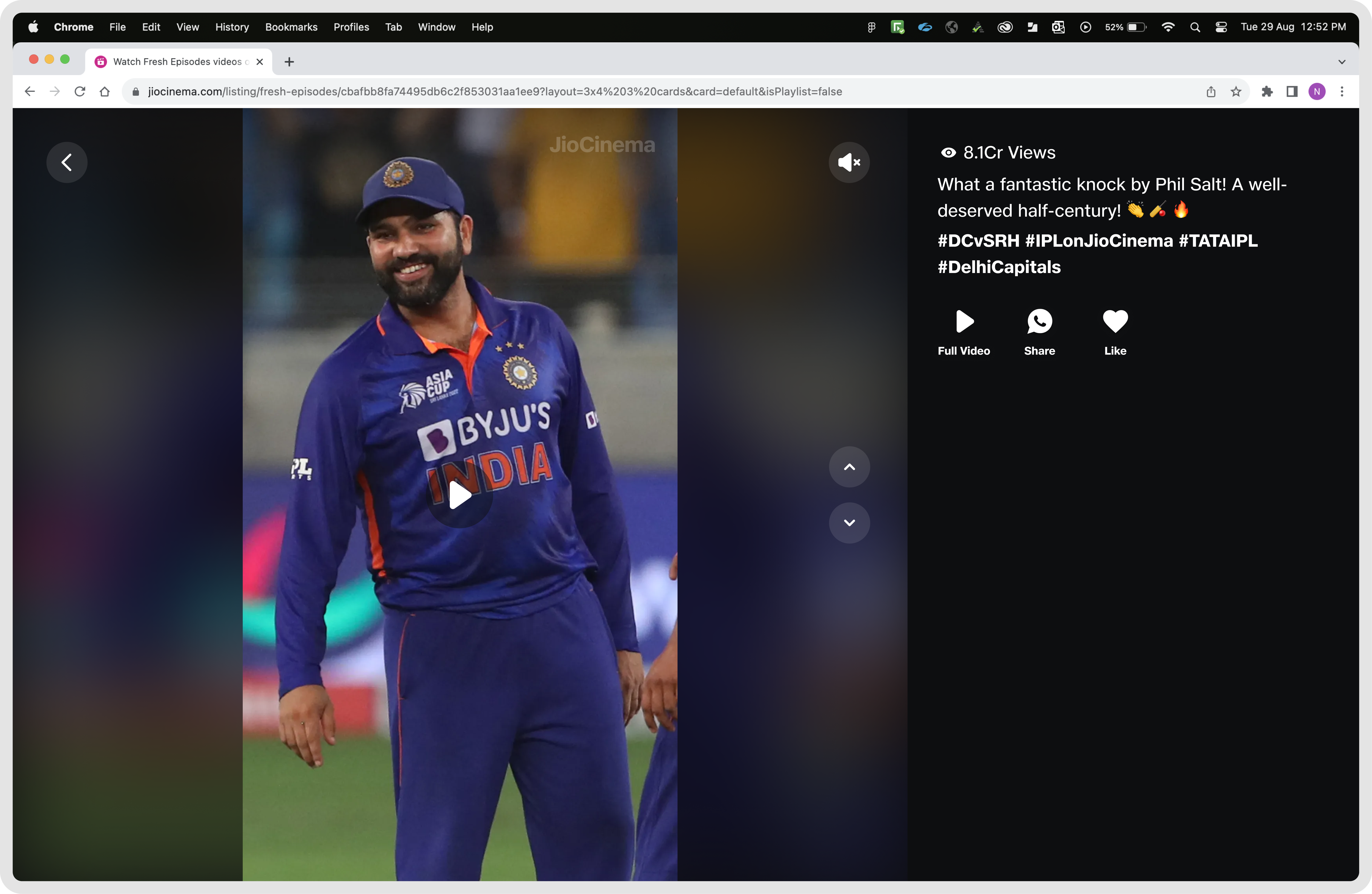
Desktop Phase 2
Clips scaled to the desktop web.
Outcome
What Clips changed
The two numbers above are the platform Clips shipped into, not Clips-specific figures — worth being precise about. What Clips itself moved:
A measurable uplift in daily active users and time-in-app, with users specifically calling out how easy it was to move between long-form and short-form content in the same session.
A new, scalable ad-monetization channel — the in-feed placements shipped as a genuinely viable revenue stream, not just an experiment.
Key learning
Full-screen vertical immersion isn’t optional — it’s the baseline for competing in short-form at all.
The creation flow has to be faster than the consumption flow; minor friction there kills content supply before it starts.
Personalization is the real retention lever — surfacing relevant content fast matters more than any single UI polish pass.